
People across East of England raise cost-of-living fears ahead of General Election
Increasing food prices and everyday living costs have been a constant pressure of families and households for the past few years.
And with less than a week until the country goes to the polls, ITV News Anglia has found out how people across the region have been coping with the cost of living crisis – and, crucially, what they would like to see from the the next government.
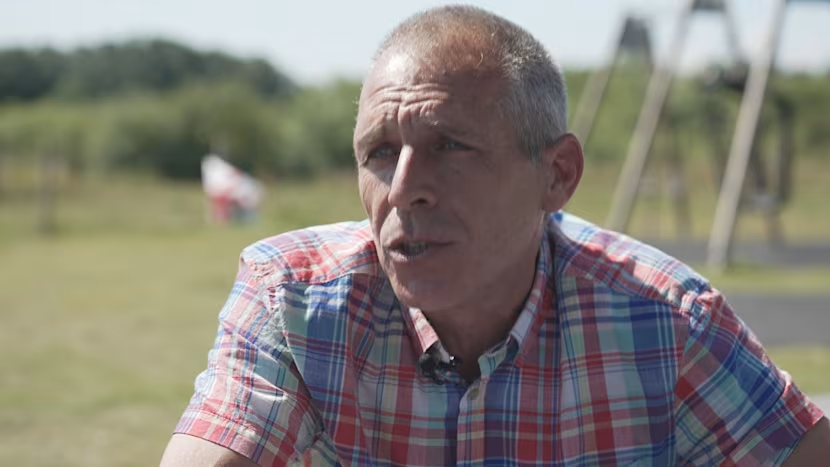
Tricia Prentice, from Colchester, who has three grown-up children, is relying on batch cooking and growing her own vegetables to reduce costs.
She said: “It’s a struggle to make ends meet and keep making the cut backs to be able to do that. I think it’s quite unfair.
“For things like gas and electric and council tax and all the basic running costs, I didn’t ever think that there would be the day I would be layering up with tops and having a blanket over my legs to keep warm.”
Families have struggled to cope with the pace of rising costs as wage growth has failed to keep up.
In 2022 inflation hit 11% and although it has slowed down prices remain significantly than they were three years ago.
The Resolution Foundation reported the UK squeezed more than a decade’s worth of “normal” inflation into just three years.
It added households generally have cut down sharply on the amount they consume during the cost-of-living crisis.
Colchester’s Anti Loo Roll Brigade, an organisation first set up to help people during the Covid pandemic, is seeing more professional working people including teachers and police officers seek help for various cost-of-living problems.
Peter Dutch, from the organisation, said: “People are so skint we are having parents who are having to choose between sending their kids to therapy for much needed help or going food shopping.”
To combat that the group is offering free counselling and therapies to support struggling families.
ITV News Anglia also spoke with parents about rising costs with many struggling to afford rising costs and choosing between a day out for their children and food “which has gone through the roof”.
But they are doubtful the situation will improve, although the new childcare support was welcomed.
Single mum Lisa Lane, who uses the Thorney, Eye and Surounding Food Hub in Cambridgeshire said the group was essential for feeding her children.
She added: “It’s the difference between being able to feed my children and not feeding them.”
Elsewhere in Cambridgeshire, Christine Nice, who runs Peterborough’s Westraven Community Cafe, said: “Customers at the moment are finding it very hard to manage all their bills, and they’re saying that the cost of living is very, very high.”
The centre operates a community fridge where customers can get free food and it also serves low-cost meals.
In Corby, Northamptonshire, people also voiced their concerns over rising costs believing the economy has not recovered since the 2008 crash and shoppers are getting much less food for their money.
Shelly Ullah, a taxi driver in the town, said: “Everything’s just gone up. I’m having to work a few extra hours a day to make ends meet.”
She added it was harder to find enough fares to cover her and her family’s living costs.
All the parties have pledged to look at the rising cost-of-living.
- The Conservatives want to introduce a series of tax cuts and reduce national insurance. They have also highlighted the recent reduction in inflation.
- The Green Party are pledging to raise the national insurance rate to 8% on annual wages above £50,270, and bring in a wealth tax of 1% annually on assets above £10 million and of 2% on assets above £1 billion.
- The Labour Party has promised to help people by banning zero-hours contacts and keep taxes, inflation and mortgages as low as possible while growing the economy.
- Liberal Democrats want to introduce a new national food strategy and a home insulation programme to tackle costs.
- Reform UK hopes to scrap the net zero target – the UK’s pledge to take as much of its greenhouse gas emissions. Reform claims that “scrapping net zero and related subsidies” would save £30bn per year.
Consumer Prices Index (CPI) inflation slowed to 2.3% in April, down from 3.2% in March, according to the Office for National Statistics (ONS).
It comes after similar research by the Resolution Foundation showed that the crisis has changed what households do with their money, with consumption being cut by more than the fall in incomes.
The UK squeezed more than a decade’s worth of “normal” inflation into just three years, according to the Foundation, which is focused on improving the living standards for those on low to middle incomes.
The Foundation said that households generally have cut down sharply on the amount they consume during the cost-of-living crisis.
https://www.itv.com/news/anglia/2024-06-28/its-the-difference-between-feeding-my-children-and-not